Certified Lean Six Sigma Yellow Belt Training Course in Dubai, Sharjah and UAE
Course Overview
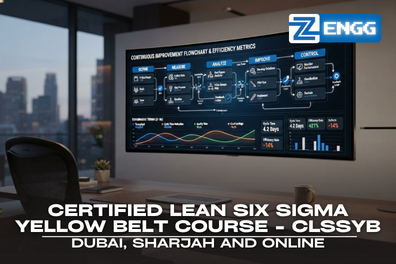
The Preparation for CLSSYB - Certified Lean Six Sigma Yellow Belt course introduces participants to the principles, tools and methods used to improve processes, reduce variation, eliminate waste and increase customer value. This Lean Six Sigma Yellow Belt Course follows the DMAIC framework, Define, Measure, Analyze, Improve and Control and helps learners understand how structured improvement projects are planned, analysed and sustained.
Participants study Lean principles, Six Sigma fundamentals, customer requirements, process mapping, data collection, basic statistics, measurement concepts, root-cause analysis, improvement techniques and process-control tools. Practical exercises and workplace scenarios provide hands-on exposure to tools such as SIPOC diagrams, Pareto charts, fishbone diagrams, FMEA and control plans, helping learners understand how these methods can be applied to real improvement activities.
The course is suitable for professionals new to Six Sigma, employees supporting improvement projects, supervisors, team leaders, and quality and operations personnel preparing for a Six Sigma Yellow Belt Certification examination. No advanced statistical background is required. Zabeel Institute offers Six Sigma Yellow Belt Training in Dubai and Sharjah, with live online learning options for professionals and organisations seeking flexible Lean Six Sigma training.
Contact Us ➔ Get Course Details ➔ Visit Our Institute ➔ Course Consultation ➔ Enroll ➔ Orientation ➔ Attending Classes ➔ Certification ➔ Career Ready ➔ Contact Us ➔ Get Course Details ➔ Visit Our Institute ➔ Course Consultation ➔ Enroll ➔ Orientation ➔ Attending Classes ➔ Certification ➔ Career Ready ➔
Detailed Course Content
This module establishes the principles behind Lean Six Sigma and explains how Lean and Six Sigma complement each other in process improvement.
Six Sigma principles and objectives.
Lean principles and process efficiency.
Variation and defect reduction.
Waste and non-value-added activity.
Customer-focused quality.
Process thinking and systems thinking.
Lean versus Six Sigma.
Integration of Lean and Six Sigma.
DMAIC methodology.
Business applications of Lean Six Sigma.
Six Sigma organisational structure.
Champions, Master Black Belts, Black Belts, Green Belts and project members.
Ethical use of data and statistical analysis.
Practical application: Participants examine how Lean can reduce waiting or unnecessary steps while Six Sigma can reduce variation in the same process.
Black Belt projects should address meaningful business problems rather than isolated process issues. This module connects improvement activity with organisational priorities.
Strategic alignment of improvement projects.
Business performance measures.
Key performance indicators.
Stakeholder analysis.
Benchmarking.
Financial and operational measures.
Project prioritisation.
Improvement portfolio planning.
Project selection criteria.
Leadership responsibilities.
Change management.
Governance and escalation.
Defining project success.
Measuring expected business impact.
Practical application: Participants evaluate potential improvement projects according to strategic importance, customer impact, financial benefit, feasibility and data availability.
Black Belts need to manage people and stakeholders as well as statistical analysis. This module develops the leadership skills required to move improvement projects forward.
Building effective improvement teams.
Team roles and responsibilities.
Team formation.
Facilitation techniques.
Team dynamics.
Conflict management.
Stakeholder communication.
Sponsor and Champion engagement.
Team coaching.
Managing resistance to change.
Decision-making techniques.
Meeting management.
Project reporting.
Management presentations.
Escalation and issue management.
Coaching Green Belts and Yellow Belts.
The Define phase establishes why the project matters, what problem is being addressed, and how success will be measured.
Voice of the Customer (VOC).
Customer requirements.
Critical-to-Quality (CTQ) characteristics.
Internal and external customers.
Problem statements.
Goal statements.
Business case development.
Project charter.
Project scope.
Project boundaries.
SIPOC diagrams.
High-level process mapping.
Stakeholder analysis.
Project risks and assumptions.
Project timelines and milestones.
Baseline requirements.
Expected benefits.
Financial impact.
Practical application: Participants can develop a project charter around problems such as invoice-processing errors, customer complaint delays, delivery performance, patient waiting time or construction rework.
The Measure phase establishes a reliable understanding of current process performance. Participants learn how to collect, validate and interpret data before attempting improvement.
Process characteristics.
Operational definitions.
Data types and measurement scales.
Data collection planning.
Sampling methods.
Stratification.
Data accuracy and integrity.
Descriptive statistics.
Mean, median and mode.
Range, variance and standard deviation.
Probability concepts.
Probability distributions.
Normal and non-normal data.
Process capability.
Process performance.
Cp and Cpk.
Pp and Ppk.
Short-term and long-term variation.
Measurement System Analysis (MSA).
Gage R&R.
Attribute measurement systems.
Baseline performance.
Defects per unit.
Defects per opportunity.
Yield.
Sigma level.
Practical application: Participants interpret process data and use Minitab-oriented analysis to establish whether a process is capable of meeting specified requirements.
The Analyze phase moves from possible causes to evidence-based root-cause validation.
Exploratory data analysis.
Graphical analysis.
Pareto charts.
Histograms.
Box plots.
Run charts.
Scatter diagrams.
Cause-and-effect diagrams.
Root cause analysis.
Five Whys.
Failure Mode and Effects Analysis (FMEA).
Correlation.
Regression.
Statistical relationships.
Hypothesis testing.
Null and alternative hypotheses.
Type I and Type II errors.
Confidence intervals.
p-values.
Statistical versus practical significance.
t-tests.
Chi-square tests.
Analysis of Variance (ANOVA).
Non-parametric tests.
Sample-size considerations.
Root-cause validation.
The emphasis is on validating potential causes with evidence, rather than treating brainstorming alone as proof of root cause.
The Improve phase focuses on selecting and implementing solutions that address verified causes.
Improvement opportunity identification.
Brainstorming techniques.
Affinity methods.
Lean improvement tools.
5S.
Standardised work.
Kaizen.
Visual management.
Kanban and pull systems.
Setup-time reduction.
Poka-yoke and error-proofing.
Waste elimination.
Future-state process mapping.
Risk assessment.
Design of Experiments (DOE).
Factor selection.
Response variables.
Experimental design.
Main effects.
Interactions.
Factorial designs.
ANOVA interpretation.
Pilot testing.
Solution selection.
Cost-benefit analysis.
Implementation planning.
Change-impact assessment.
Improvement decision framework:
Has the root cause been confirmed?
Does the solution directly address the cause?
What benefit is expected?
What risks could the solution introduce?
Can it be implemented within the project constraints?
How will the improvement be measured and controlled?
The Control phase protects the gains achieved during improvement and transfers ownership to the process team.
Statistical Process Control (SPC).
Control-chart selection.
Continuous-data control charts.
Attribute-data control charts.
X-bar and R charts.
X-bar and S charts.
Individuals and Moving Range charts.
p charts.
np charts.
c charts.
u charts.
Control limits.
Specification limits.
Common-cause variation.
Special-cause variation.
Control plans.
Process documentation.
Standard Operating Procedures.
Visual controls.
Process ownership.
Response plans.
Audits and compliance checks.
Performance monitoring.
Sustainment metrics.
Benefits validation.
Project closure.
Lessons learned.
The objective is not simply to implement an improvement, but to ensure that the improved process continues to perform after the project is handed back to the process owner.
Minitab is used as a practical statistical-analysis environment throughout relevant parts of the programme.
Importing and preparing data.
Worksheet structure.
Data types.
Descriptive statistics.
Graphical analysis.
Pareto charts.
Histograms.
Box plots.
Process capability analysis.
Measurement System Analysis.
Control charts.
Correlation.
Regression.
Hypothesis testing.
ANOVA.
Design of Experiments.
Interaction analysis.
Interpreting statistical output.
Presenting analytical findings.
Communicating statistical results to non-technical stakeholders.
Avoiding common analysis errors.
The final application brings the DMAIC framework together through a practical case study or project-based exercise.
Participants work through the stages of:
Defining a business problem.
Developing a project charter.
Identifying the Voice of the Customer.
Mapping the current process.
Creating a data collection plan.
Assessing measurement reliability.
Establishing baseline performance.
Analysing potential causes.
Validating root causes.
Selecting an improvement solution.
Testing or piloting the solution.
Developing a control plan.
Presenting findings and recommendations.
Identifying expected business benefits.
A practical training project or classroom case study should not be represented as satisfying an external certification body's project requirement unless the relevant certification provider explicitly accepts it.
Why Study This Course?
•Learn how Lean and Six Sigma tools are applied to real process-improvement challenges.
•Understand the complete DMAIC framework from problem definition to process control.
•Build practical skills in process mapping, data collection and root-cause analysis.
•Develop a structured foundation for Six Sigma Certification preparation.
•
Support Green Belt and Black Belt teams more effectively in improvement projects.
•Apply Lean Six Sigma concepts across service, operations, quality and business processes.
Who Can Enroll in This Course?
•Beginners who want to learn the fundamentals of Lean Six Sigma.
•
Graduates and career changers interested in quality and process improvement.
•Working professionals involved in operations, service delivery or business processes.
•Quality assurance and quality-control professionals.
•Supervisors, managers and team leaders responsible for process performance.
•Employees supporting continuous-improvement, DMAIC or operational-excellence projects.
Why Choose Zabeel Institute?
•Certified Instructors: Experienced instructors with industry expertise.
•Flexible Scheduling: Choose weekday, weekend, or online classes that suit your availability.
•Industry-Relevant Curriculum: Practical exercises based on realistic workplace processes and improvement scenarios.
•Official Certifications: Zabeel Certificate will be provided after course completion. KHDA Attendance Attested Certificates are available for courses.
•Hands-On Training: A guided learning pathway that supports progression from Yellow Belt foundations to more advanced Lean Six Sigma study.
Zabeel Institute has been a leading professional training provider in the UAE since 1988, trusted by corporate and individual learners across Dubai, Sharjah, and Online.
Learning Outcomes
After completing this Course, participants will be able to:
•Apply DMAIC concepts to a structured process-improvement problem.
•Create basic project charters, SIPOC diagrams and process maps.
•Collect and interpret simple process data using appropriate quality tools.
•Identify waste, variation, defects and potential root causes.
•Use tools such as Pareto charts, fishbone diagrams, 5 Whys and basic FMEA.
•Develop basic improvement, control and monitoring plans for sustained process performance.
Career Outcomes
Certification & Pass Rate
The course is structured as preparation for CLSSYB - Certified Lean Six Sigma Yellow Belt and can support candidates preparing for an applicable external certification examination. Participants who successfully complete the Zabeel Institute training requirements will receive a Zabeel Institute certificate of completion.
CSSC certification and training-course completion are separate outcomes: completing training does not by itself mean that an external certification has been awarded. Zabeel also offersASQ Certified Six Sigma Yellow Belt (CSSYB) preparation, it should be treated as a separate pathway.
Corporate Training Courses
The Six Sigma Yellow Belt Course can be delivered as corporate training for organisations seeking to develop a common understanding of Lean Six Sigma, quality improvement and process performance. Organisations can also explore Zabeel Institute's Corporate Training solutions for role-specific and team-based professional development.
A Lean Six Sigma Yellow Belt Course provides foundational knowledge of Lean principles, Six Sigma concepts and the DMAIC improvement methodology. Participants learn how to identify process problems, recognise waste and variation, collect basic data, use quality tools and support structured improvement projects. Yellow Belt training is generally suitable for people who are new to Lean Six Sigma or who participate in improvement teams.
Is the Six Sigma Yellow Belt Course suitable for beginners?+
Yes. The course is designed as a foundation-level learning programme and does not require previous Six Sigma certification or advanced statistical knowledge. Participants should be comfortable with basic workplace processes, simple charts and numerical information. The training begins with Lean Six Sigma fundamentals before progressing through DMAIC, process analysis, data collection and improvement tools.
What will I learn in this Lean Six Sigma Training Course?+
You will learn Lean and Six Sigma fundamentals, DMAIC, customer requirements, project charters, SIPOC, process mapping, data collection, descriptive statistics, measurement concepts, Pareto analysis, root-cause analysis, FMEA, basic hypothesis-testing concepts, Kaizen, 5S, error-proofing, control plans and process monitoring.
Do I need advanced mathematics or statistics knowledge?+
No. Advanced mathematics is not required for this Yellow Belt programme. Participants work with foundational concepts such as percentages, averages, variation, charts, basic descriptive statistics and simple data interpretation. More advanced statistical analysis, detailed hypothesis testing and Design of Experiments are generally developed further in higher-level Lean Six Sigma training.
Does this Lean Six Sigma Yellow Belt Course include CLSSYB certification examination?+
The course is designed to prepare participants for the CLSSYB examination, but whether an examination fee or registration is included should be confirmed based on the selected training arrangement. External certification requirements, examination format, eligibility and registration conditions are determined by the relevant certification provider.
What certificate will I receive after completing the course?+
Participants who successfully meet Zabeel Institute's training requirements receive a certificate of completion from Zabeel Institute. If you plan to obtain an external CLSSYB certification, that credential is separate and subject to the examination and certification requirements of the relevant external provider.
Is the Lean Six Sigma Yellow Belt Course available in Dubai or Sharjah?+
Zabeel Institute provides professional training options for learners in Dubai and Sharjah. Live online learning may also be available for professionals who require a more flexible study format. The available schedule and delivery method should be confirmed when enrolling, as course formats can vary.
Can I take an Online Six Sigma Yellow Belt Course?+
Yes, live online learning can support professionals who are unable to attend classroom training. Online delivery can cover the same core Lean Six Sigma concepts, DMAIC stages, quality tools, practical exercises and examination preparation activities, depending on the confirmed course format and schedule.
What career opportunities can Lean Six Sigma Yellow Belt training support?+
Yellow Belt training can support professional development in roles involving quality, operations, process improvement, business analysis, project support, service delivery and continuous improvement. The certification alone does not guarantee employment, but the ability to understand process data, identify inefficiencies and contribute to improvement projects can be relevant across multiple industries.
Can organisations arrange Six Sigma Yellow Belt Training for employees?+
Yes. Organisations can arrange corporate Lean Six Sigma training to help teams develop a common process-improvement vocabulary and apply consistent quality tools. Corporate programmes can be adapted around relevant business processes, industry requirements, departmental challenges and improvement priorities, with delivery options based on organisational requirements.