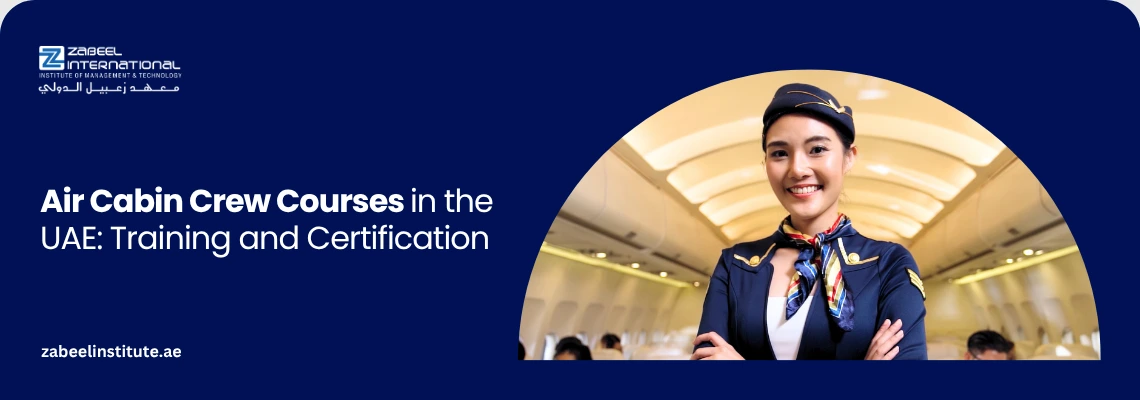
Air Cabin Crew Courses in the UAE: Training and Certification
Air cabin crew courses introduce aspiring flight attendants to the knowledge and professional skills required to work in an aircraft cabin. Depending on the programme, the curriculum can cover the airline industry, aircraft familiarisation, crew coordination, passenger service, onboard safety, emergency procedures and aviation security awareness.
For anyone considering a cabin crew career in the UAE, understanding the course syllabus, certification process and airline recruitment requirements is an important first step. A suitable training programme can help candidates understand the responsibilities of the profession and prepare for relevant assessments, but it does not guarantee employment with an airline.
The International Air Transport Association (IATA) publishes an Airline Cabin Crew Training course covering core aviation knowledge, passenger interactions, safety procedures and recruitment preparation. Candidates exploring training in the UAE can review the IATA Cabin Crew Training Course in Dubai and Sharjah offered by Zabeel Institute to learn about the course content and available training arrangements.
Key Takeaways
- Course content: Air cabin crew courses introduce aviation fundamentals, aircraft types, communication, passenger service and onboard safety procedures.
- IATA certification: The IATA Airline Cabin Crew Training course awards an IATA Certificate of Completion to participants who pass its final examination.
- Course duration: Duration depends on the delivery format. IATA publishes a 45–60-hour self-study course, while Zabeel’s course page describes a two-month training schedule.
- Airline eligibility: Requirements for age, education, English proficiency, height, reach and experience vary by airline.
- Employment expectations: A cabin crew certificate can support professional preparation, but each airline controls its own recruitment, selection and employee training processes.
What Do You Learn in an Air Cabin Crew Course?
An air cabin crew course introduces the responsibilities of working in an aircraft cabin. It combines knowledge of the airline industry with communication skills, passenger service and an understanding of safety-related procedures.
IATA’s published Airline Cabin Crew Training syllabus includes several core learning areas.
Training area |
What it covers |
|---|---|
| Airline industry and aircraft | Introduction to the airline industry, aircraft types and cabin crew responsibilities. |
| Crew coordination and communication | The importance of communication, teamwork and coordination among crew members. |
| Customer service | Managing passenger interactions and responding professionally in different situations. |
| Safety and emergency procedures | Understanding onboard safety responsibilities and procedures for unusual situations. |
| Aircraft familiarisation | An introduction to narrow-body and wide-body aircraft through the course’s virtual cabin walkthrough. |
| Dangerous goods awareness | General principles relating to dangerous goods and the risks associated with their transport on aircraft. |
| Aviation security awareness | An introduction to security-related issues relevant to the cabin crew role. |
| Recruitment preparation | Guidance on professional expectations and aspects of the airline recruitment process. |
The precise syllabus depends on the programme and course version. Candidates should consult the official IATA Airline Cabin Crew Training course information and confirm the syllabus applicable to their enrolment.
Why Are Safety and Customer Service Both Important?
Cabin crew responsibilities extend beyond welcoming passengers and providing onboard service. Crew members must follow procedures, communicate with colleagues, remain alert to potential risks and respond appropriately to situations that could affect passenger safety.
Customer service is also an essential part of the role. Cabin crew members may assist passengers with different needs, respond to requests, manage concerns and help maintain an orderly cabin environment.
Candidates who want to develop a broader understanding of passenger communication and service expectations can explore the Airline Customer Service Fundamentals Course.
Those preparing for the profession should also understand the skills needed for an airline cabin crew career, including communication, teamwork, adaptability and professional customer care.
What Is an IATA Cabin Crew Training Certificate?
The IATA Airline Cabin Crew Training course introduces aspiring cabin crew members to the industry, onboard responsibilities, passenger interactions and procedures for unusual situations during a flight.
According to IATA, participants who successfully pass the final examination receive an IATA Certificate of Completion.
It is important to distinguish a training certificate from an airline employment qualification. Completing a course demonstrates that a participant has met the completion requirements of that course. It does not automatically make the candidate eligible for every airline vacancy, guarantee an interview or guarantee a job offer.
Airlines establish their own recruitment criteria and may require candidates to complete additional assessments and airline-specific training after selection.
What Examination Is Included in IATA Airline Cabin Crew Training?
IATA publishes examination information for its Airline Cabin Crew Training self-study course, identified by course code ALC005EBEN01.
Examination detail |
Published IATA information |
|---|---|
| Course code | ALC005EBEN01 |
| Examination format | 100 multiple-choice questions |
| Time allowance | Three hours |
| Passing grade | 60% correct answers |
| Distinction grade | 90% correct answers |
| Examination attempts | Two |
| Examination method | Online examination with remote supervision |
These details relate to the specific IATA course identified above. Students enrolling through a training provider should confirm the exact course version, examination arrangements and certificate awarded for their registration.
For complete information, consult the official IATA course and examination details.
How Long Do Air Cabin Crew Courses Take?
The duration of air cabin crew courses depends on the programme, study format, timetable and training provider.
IATA describes its Airline Cabin Crew Training self-study course as approximately 45–60 hours, depending on the participant’s previous knowledge and experience. The course uses e-book materials and has a 12-month enrolment validity for completing the course and examination.
Zabeel Institute‘s published cabin crew course page describes a two-month training schedule with weekday and weekend options. It also lists study materials, learning management system (LMS) access, continuous assessments, online practice work and mock examinations.
| Course consideration | IATA self-study format | Zabeel’s published training schedule |
|---|---|---|
| Duration | Approximately 45–60 hours | Two months (24 Hours) |
| Delivery | Self-study using e-book materials | Training schedule with weekday and weekend options |
| Study support | Published course materials and online resources | LMS access, assessments and mock exams listed on the course page |
| Examination | Specified by IATA for the relevant course | Examination registration assistance is listed on Zabeel’s page; confirm the applicable exam arrangements |
These formats should not be assumed to be identical. Before enrolling, confirm the course code, actual timetable, total study hours, examination format, materials and any additional charges.
Prospective students can review the IATA Cabin Crew Training Course at Zabeel Institute for the provider’s published training details.
What Qualifications Do You Need to Become Cabin Crew in the UAE?
Cabin crew eligibility requirements vary by airline. Some airlines specify a minimum age, educational qualification, English proficiency, physical requirements and customer service experience.
The following examples are based on the recruitment criteria published by Emirates and Etihad Airways.
| Requirement | Emirates | Etihad Airways |
|---|---|---|
| Minimum age | 21 years | 21 years |
| Height and reach | At least 160 cm tall and able to reach 212 cm | Minimum height of 163 cm |
| Education | Minimum high school education, Grade 12 | High school graduate, Grade 12 or equivalent |
| English proficiency | Fluent in written and spoken English | Fluent in written and spoken English |
| Experience | At least one year of hospitality or customer service experience | Check the relevant vacancy for applicable experience requirements |
Emirates also specifies that candidates must meet UAE employment visa requirements and have no visible tattoos while wearing its cabin crew uniform. Always check the current eligibility information on the Emirates Cabin Crew Careers website and the Etihad Airways Cabin Crew Careers website.
These are examples of two airlines’ recruitment criteria, not universal requirements for all cabin crew positions.
Before choosing a training course, candidates should assess their education, communication abilities, professional experience and readiness to meet their preferred airline’s criteria.
For a more detailed explanation, read our guide to qualifications for cabin crew jobs in the UAE.
Does an IATA Cabin Crew Certificate Guarantee an Airline Job?
No. An IATA cabin crew training certificate does not guarantee employment with an airline.
Training can help candidates understand the profession, develop relevant knowledge and prepare for certain aspects of recruitment. However, airlines make their own hiring decisions according to their eligibility criteria, interviews, assessments, operational requirements and available vacancies.
For example, Emirates provides information about its own recruitment process and training programme for recruited cabin crew members. Etihad also publishes its own eligibility criteria and recruitment information.
Candidates should therefore distinguish between three stages:
- Pre-employment training: Learning about the aviation industry, cabin crew responsibilities, passenger service and relevant safety concepts.
- Airline recruitment: Meeting an airline’s eligibility criteria and successfully completing its application, interview and selection process.
- Airline-specific training: Completing the training and assessments required by the employer after recruitment.
Before enrolling, ask a training provider exactly what its course includes, which certificate is awarded and what career support is available. Be cautious of claims that a certificate automatically guarantees an airline position.
Also Read
- How Much Are Cabin Crew Courses Fees in Dubai?
- What qualifications do I need to get cabin crew jobs in uae?
- Who is the cabin crew in airlines?
- Can the Right Course Boost Your Air Hostess Salary Potential?
What Should You Check Before Choosing a Cabin Crew Course?
Comparing courses involves more than considering the advertised duration or certificate name. Candidates should understand what they will study, how the course is assessed and what support is available.
Use the following checklist when evaluating air cabin crew courses in Dubai, Sharjah or elsewhere in the UAE.
1. Verify the course details.
Check the exact course name and code, certificate awarded and provider information. Where IATA authorisation is claimed, ask how the provider’s current status and relevant course offering can be verified.
2. Review the syllabus.
Look for clear information on aviation fundamentals, aircraft familiarisation, crew communication, passenger interactions and safety-related topics.
3. Confirm the learning format.
Establish whether the course is self-study, classroom-based or instructor-supported. Ask for the actual timetable and required study hours.
4. Understand the examination arrangements.
Confirm whether examination registration, practice tests, mock examinations and learning materials are included.
5. Request a complete fee breakdown.
Ask about tuition, examination charges, learning materials and other applicable costs before paying.
6. Understand career support.
Clarify whether the provider offers interview preparation, application guidance or general career advice. Do not assume that these services include a job placement.
7. Check the current course information.
Schedules, fees and examination arrangements can change. Obtain confirmation for the intake you intend to join.
Candidates considering training in Dubai or Sharjah can review the IATA Cabin Crew Training Course at Zabeel Institute and confirm the current syllabus, schedule, assessment and enrolment details before making a decision.
What Other Aviation Courses Can You Consider?
Cabin crew training is one of several professional pathways within aviation, travel and tourism. The most suitable option depends on whether a candidate is interested in working onboard an aircraft, assisting travellers or contributing to airport operations.
Travel and Tourism
People interested in travel agency operations, tourism services and the broader travel industry can explore the IATA Foundation Travel & Tourism Certification Training Course.
This programme has a different learning focus from cabin crew training. Candidates should compare its syllabus and intended career outcomes with their own goals before choosing between the two.
Airport Operations
People interested in the operational side of the aviation industry can consider the IATA Airport Operations Training Course.
Airport operations training focuses on airport functions and operational activities rather than the specific onboard responsibilities of cabin crew.
Airline Customer Service
Customer-facing roles are also relevant to people exploring aviation and travel careers. Training in customer service can support the development of communication and passenger-handling skills, although the content and intended outcomes depend on the programme.
Candidates who want to compare aviation, travel and airport training options can explore the IATA training programmes available through Zabeel Institute.
These courses address different skills and occupational pathways. Completing one does not automatically qualify a candidate for another role, so prospective students should compare each course’s learning objectives before enrolling.
IATA Cabin Crew Training at Zabeel Institute
Zabeel Institute publishes an IATA Cabin Crew Training Course for aspiring flight attendants and cabin crew candidates in Dubai and Sharjah.
The institute’s course page describes the following learning areas and study arrangements:
- Introduction to the airline industry and aircraft.
- Crew member coordination and communication.
- Customer service and passenger interactions.
- Safety and emergency procedures.
- A published two-month training schedule with weekday and weekend options.
- Learning materials, LMS access, assessments and mock examinations.
- Assistance with IATA examination registration.
These details reflect the information published on the course page and should be confirmed with the institute for the intended intake. Students should also verify the applicable IATA course version, examination requirements, certificate, fee inclusions and schedule before registering.
An IATA cabin crew course can be one component of professional preparation for a career in aviation. Airline eligibility, recruitment and any employer-specific training remain separate requirements.
Explore the IATA Cabin Crew Training Course in Dubai and Sharjah to review the course details and enquire about the current training schedule.
FAQs
What do air cabin crew courses teach?
Air cabin crew courses introduce the airline industry, aircraft types, crew communication, passenger service and onboard safety procedures. The exact syllabus varies by programme.
Is an IATA cabin crew certificate enough to get an airline job?
No. The IATA Certificate of Completion confirms successful completion of the relevant course and examination. Airlines have their own eligibility criteria, recruitment processes and training requirements.
How long does an IATA cabin crew course take?
IATA publishes its Airline Cabin Crew Training self-study course as approximately 45–60 hours. Zabeel Institute’s current published course page describes a two-month training schedule. Confirm which format and course version apply to your enrolment.
Do I need to complete a cabin crew course before applying to an airline?
Requirements vary by airline and vacancy. Candidates should check the official recruitment criteria of their preferred employer instead of assuming that every airline requires an external cabin crew certificate.
What are the age and height requirements for cabin crew in the UAE?
Requirements differ between airlines. For example, Emirates publishes a minimum age of 21 years, a minimum height of 160 cm and a reach of 212 cm. Etihad publishes a minimum age of 21 years and a minimum height of 163 cm. Check their official careers websites for current requirements.
Can I study cabin crew training in Dubai or Sharjah?
Zabeel Institute publishes an IATA Cabin Crew Training Course for Dubai and Sharjah. Contact the institute to confirm the current venue, timetable, fees and examination arrangements.
What certificate is awarded after IATA cabin crew training?
IATA states that participants who successfully pass the final examination for its Airline Cabin Crew Training course receive an IATA Certificate of Completion. Confirm the specific course version and certificate applicable to your enrolment.
Are cabin crew training and airport operations training the same?
No. Cabin crew training focuses on the onboard role, including passenger interactions and cabin safety responsibilities. Airport operations training focuses on the functions and activities involved in airport operations.
Training Centers in UAE: Dubai, Sharjah and Online (Global)
Zabeel Institute is a government-approved professional training institute in the UAE, offering Air hostess Training Course in Sharjah and Dubai. With a strong legacy in executive and professional education, the institute’s Trending Cabin Crew Course in UAE is presented as structured, industry-relevant, and compliance-focused training designed to meet current industry standards.
Institutional Credibility & Regulatory Approval
- Established in 1988 with 37+ years of professional training experience
- Approved by KHDA – Knowledge and Human Development Authority, Dubai, UAE
- Institutionally listed in the KHDA Training Institute Directory
- Institutional approvals and licensing are publicly verifiable through UAE education authorities
Learnings and Recommendations
- Structured coverage of course fundamentals and applied certification techniques
- Customized learning pathways based on the learner’s background and experience
- Ongoing academic support, guided practice, and exam preparation tips from certified instructors
- Training delivered by certified instructors with real-world experience for job-ready skills
- Students can explore course academies such as:
IATA Training Course | Engineering Training Course | Accounting and Finance Course | IT Training Course | Language Training Course | Logistics Training Course | Management Training Course | Soft Skills Training Course | Healthcare Training Course | Online Course | Corporate Training & More Training Course
To know more about course fees, certification structure, eligibility, schedules, and learning modes, learners may contact Zabeel Institute through official channels:
- Phone: 600 52 4448 | +971 4 397 4905
- WhatsApp: +971544459650
- Email: mail@zabeelinstitute.ae
- Website: www.zabeelinstitute.ae
- Official Social Media: Facebook, LinkedIn, Instagram, YouTube, Twitter, TikTok
To know more about course terms and definitions, visit Zabeel Glossary Page.
If you are looking to enroll in Cabin Crew Training courses in UAE and want to learn more about online IATA Airline courses, certification, and fees, get in touch with Zabeel Institute.
Conclusion
Air cabin crew courses introduce aspiring flight attendants to the aviation industry, passenger service, crew responsibilities and onboard safety. Choosing an appropriate programme involves reviewing the syllabus, learning format, examination arrangements, certification and the provider’s current course information.
An IATA cabin crew training certificate can support a candidate’s preparation, but it does not replace airline recruitment criteria or guarantee employment. Candidates should verify important details through official IATA and airline sources before enrolling.
For prospective students in the UAE, the next step is to review the IATA Cabin Crew Training Course in Dubai and Sharjah at Zabeel Institute and confirm the available training arrangements.
Ready to Start Your Learning Journey? Explore Airline – IATA Training Courses at Zabeel Institute
About the Author and Review
- Author: Content Researcher at Zabeel International Institute
- Reviewed by: Senior Instructor
All course materials and learning frameworks are professionally designed, reviewed, and delivered by subject-matter experts, ensuring accuracy, relevance, and academic integrity.