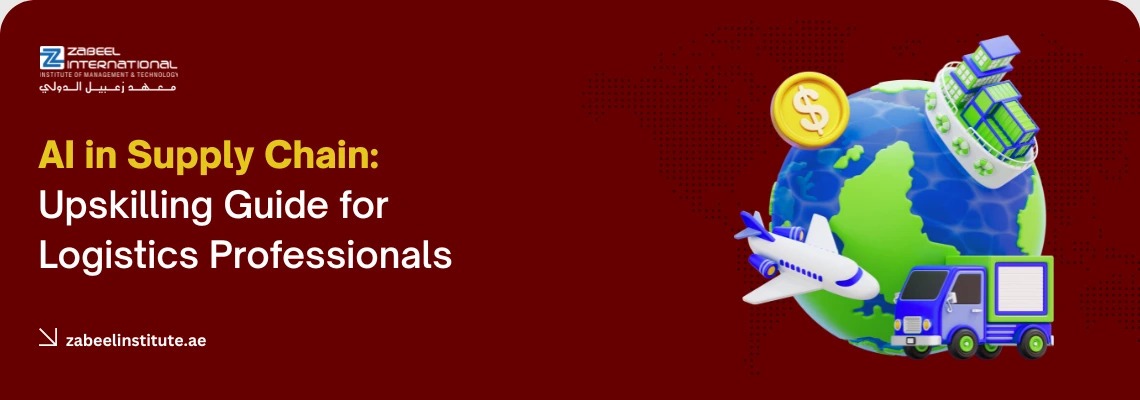
AI in Supply Chain Management: An Upskilling Guide for Logistics and Supply Chain Professionals
Artificial intelligence is quietly reshaping how goods are forecast, made, moved, stored, and delivered. For logistics and supply chain professionals, AI in supply chain management is no longer a future concept, it is becoming a core skill. This upskilling guide explains what AI in supply chain means, how it is actually used, the benefits, the skills professionals need, and how to learn them, with a focus on what matters for the UAE and Gulf logistics sector.
Key Takeaways
What Is AI in Supply Chain Management?
Quick answer: AI in supply chain management is the use of artificial intelligence, including machine learning, predictive analytics, and increasingly generative and agentic AI, to plan, optimize, and automate activities across forecasting, procurement, inventory, warehousing, transportation, and risk management.
As IBM explains, AI is transforming how supply chains are planned, managed, and optimized by processing large amounts of data, predicting trends, and performing complex tasks. In practical terms, it means software that can forecast demand more accurately, flag disruptions before they spread, suggest cheaper or faster routes, and automate repetitive planning work that used to consume a planner’s day.
This matters because modern supply chains generate enormous data, orders, shipments, inventory levels, weather, traffic, supplier lead times, far more than any team can process manually. AI turns that data into decisions.
How AI Is Used in Logistics and Supply Chain
AI is applied across nearly every link of the supply chain. The most common, practical uses are:
- Demand forecasting. Machine-learning models analyze historical sales, seasonality, promotions, and external signals to predict demand more accurately than traditional spreadsheets, reducing both stockouts and overstock.
- Inventory optimization. AI recommends reorder points and safety stock by product and location, balancing service levels against working capital.
- Warehouse automation. Computer vision, robotics, and AI-driven slotting improve picking, packing, and storage efficiency, as AI tackles fragmented, hard-to-connect supply networks.
- Transportation and route planning. AI optimizes routes, loads, and delivery sequencing in real time, accounting for traffic, fuel cost, and delivery windows.
- Procurement automation. AI monitors suppliers, predicts price movements, automates purchase orders, and flags supplier risk.
- Risk and disruption prediction. Predictive analytics warn of delays, demand spikes, or supplier failures early enough to act, supporting the resilience and cost goals Oracle outlines.
Benefits of AI in the Supply Chain
| Benefit | What it means in practice |
| Lower costs | Less overstock, fewer expedited shipments, optimized routes and labor |
| Higher forecast accuracy | Data-driven demand predictions replace manual estimates |
| Improved service levels | Fewer stockouts and late deliveries |
| Faster decisions | Real-time recommendations instead of weekly planning cycles |
| Greater resilience | Early warning of disruptions and supplier risk |
| Productivity gains | Automation of repetitive planning and documentation tasks |
Real-World AI Use Cases Across the Supply Chain
| Supply chain area | AI use case | Typical outcome |
| Demand planning | ML-based demand forecasting | Reduced stockouts and excess inventory |
| Inventory | Reorder-point and safety-stock optimization | Lower holding cost, better availability |
| Warehouse | Vision-based picking, dynamic slotting | Faster fulfilment, fewer errors |
| Transportation | Dynamic route and load optimization | Lower fuel cost, faster delivery |
| Procurement | Supplier risk monitoring and auto-reordering | Reduced manual workload and risk |
| Risk management | Disruption prediction and scenario simulation | Faster, more confident response |
Also Read
- Professional Courses in Sharjah: How to Choose the Right Career & Certification Course
- Which Arabic Course in Dubai Is Right for You?
- Which Training Institute Offers The Best Generative AI Course?
- AI and Artificial Intelligence: Is It Worth Learning?
Why It Matters for the UAE and Gulf Logistics Sector?
The UAE sits at the crossroads of global trade, and Dubai is a major regional logistics and aviation hub. As operations digitize, demand is growing for professionals who understand both supply chain and AI, not as separate fields, but together. The UAE’s own National Strategy for Artificial Intelligence 2031 signals a national push to adopt AI across sectors, and logistics is a natural beneficiary given the country’s ports, free zones, airlines, and freight corridors.
For professionals in Dubai, Sharjah, and the wider GCC, this means AI literacy is becoming a differentiator in hiring and promotion, the ability to interpret AI-driven forecasts, question them intelligently, and apply them to real operations.
What Skills Do Supply Chain Professionals Need for AI?
You do not need to become a software engineer. The skills that matter most for supply chain professionals are practical and layered:
- AI literacy: understanding what machine learning, predictive analytics, and generative AI can and cannot do, and where they fit in a supply chain.
- Data fluency: working confidently with data in tools like Excel and basic analytics platforms, the foundation for any AI application.
- Domain application: knowing how to apply AI to forecasting, inventory, warehouse, transportation, and procurement decisions.
- Tool awareness: familiarity with transportation and warehouse management systems, IoT tracking, and AI-enabled planning tools.
- Critical judgment: knowing when to trust automation and when human judgment must override it, a capability SAP describes as essential as AI takes on more decisions.
- Ethics and governance: handling data privacy, bias, and responsible use, increasingly expected by UAE employers.
Can You Learn AI for Supply Chain Without Coding?
Quick answer: Yes. Many AI-for-supply-chain courses are designed for working professionals and assume no advanced programming, focusing on concepts, tools, and real applications rather than building models from scratch.
If you are a logistics, procurement, or operations professional, the most relevant starting point is an applied course that teaches AI concepts, demand forecasting, inventory and route optimization, and hands-on case studies, exactly the focus of Zabeel’s AI For Logistics and Supply Chain course, which states that no advanced programming is required and familiarity with ERP or data tools is helpful but not mandatory.
How to Get Started?
- Build foundations. Start with core AI concepts and data fluency, an Introduction to AI course or a broader AI course in Dubai, Sharjah, or online gives you the vocabulary.
- Specialize for your field. Move into an applied, supply-chain-focused program like the AI For Logistics and Supply Chain course, which covers demand forecasting, inventory optimization, route planning, warehouse automation, IoT tracking, and predictive analytics with hands-on case studies.
- Layer in supply chain fundamentals. If you are new to logistics itself, pair your AI learning with recognized supply chain credentials and logistics training to strengthen domain knowledge.
- Apply at work. Use a real forecasting, inventory, or routing problem from your own operation as a project, this is where learning becomes capability.
- Keep current. AI in supply chain is moving fast; Gartner predicts that by 2030 half of supply chain management solutions will include agentic AI capabilities, so ongoing learning is part of the job.
FAQs
What is AI in supply chain management?
AI in supply chain management is the use of artificial intelligence, machine learning, predictive analytics, and generative and agentic AI, to plan, optimize, and automate forecasting, procurement, inventory, warehousing, transportation, and risk management across the supply chain.
How is AI used in logistics?
AI is used for demand forecasting, inventory optimization, warehouse automation, transportation and route planning, procurement automation, and risk and disruption prediction, turning large volumes of supply chain data into faster, better decisions.
What are the benefits of AI in supply chain?
The main benefits are lower costs, higher forecast accuracy, improved service levels, faster decisions, greater resilience, and productivity gains from automating repetitive planning and documentation tasks.
What skills do supply chain professionals need for AI?
AI literacy, data fluency, domain application (how AI fits forecasting, inventory, warehouse, transportation, and procurement), tool awareness, critical judgment about when to override AI, and awareness of ethics and governance.
Can I learn AI for supply chain without coding?
Yes. Many applied AI-for-supply-chain courses are built for working professionals and assume no advanced programming, focusing on concepts, tools, and real applications. Zabeel’s AI For Logistics and Supply Chain course is one such example.
How do I start a career in AI for logistics?
Start with AI foundations and data fluency, then specialize with an applied supply-chain-focused AI course, layer in recognized logistics credentials, and apply the learning to a real problem at work. This combination is what makes you employable in AI-enabled supply chain roles.
Is AI in supply chain worth learning?
Yes. AI adoption in supply chain is accelerating, with analysts forecasting that by 2030 half of SCM solutions will include agentic AI capabilities (Gartner, 2025). For logistics professionals, AI literacy is fast becoming a hiring and promotion differentiator.
Training Centers in UAE: Dubai, Sharjah and Online (Global)
Zabeel Institute is a government-approved professional training institute in the UAE, offering AI for Procurement and Supply Chain Course in Sharjah and Dubai. With a strong legacy in executive and professional education of the institute, Trending AI for Supply Chain Course in UAE is recognized for delivering structured, industry-relevant, and compliance-focused training programs designed to meet current industry standards.
Institutional Credibility & Regulatory Approval
- Established in 1988 with 37+ years of professional training experience
- Approved by KHDA – Knowledge and Human Development Authority, Dubai, UAE
- Officially listed in the KHDA Training Institute Directory
- Institutional approvals and licensing are publicly verifiable through UAE education authorities
Learnings and Recommendations
- Structured coverage of course fundamentals and applied certification techniques
- Customized learning pathways based on the learner’s background and experience
- Ongoing academic support, guided practice, and exam preparation tips from certified instructors
- Training delivered by certified instructors with real-world experience for job-ready skills
- Student enroll in course academies like: IATA Training Courses | Engineering Training Courses | Accounting and Finance Courses | IT Training Courses | Language Training Courses | Logistics Training Courses | Management Training Courses | Soft Skills Training Courses | Healthcare Training Courses | Online Courses | Corporate Training & More Training Courses
Get in touch to know more about course fees, certification structure, eligibility, schedules, and learning modes, learners may contact Zabeel Institute through official channels:
- Phone: 600 52 4448 | +971 4 397 4905
- WhatsApp: +971544459650
- Email: mail@zabeelinstitute.ae
- Website: www.zabeelinstitute.ae
- Official Social Media: Facebook, LinkedIn, Instagram, YouTube, Twitter, TikTok
To know more about course and definitions, visit Zabeel Glossary Page
Conclusion
AI in supply chain management is transforming logistics from a mostly reactive function into a predictive, optimized, and increasingly automated one. For professionals in the UAE and Gulf, the opportunity is clear: the people who understand both supply chain and AI, and can apply them together, will lead the next phase of the industry. The good news is that you do not need to become a programmer to get there.
If you are looking to Enroll in AI for Logistics and Supply Chain Course in UAE and land in perfect job or If you want to know more about Online Healthcare Course, Training, Certification and Fees,
About the Training Institute
Zabeel Institute is a well-established training provider in Dubai offering a wide range of professional and language courses. Known for its experienced trainers and practical approach, the institute delivers high-quality training tailored to industry needs. Their courses focus on real-world communication, helping learners build confidence and achieve measurable results.
About the Author and Review
- Author: Content Researcher at Zabeel International Institute
- Reviewed by: Senior Instructor
All course materials and learning frameworks are professionally designed, reviewed, and delivered by subject-matter experts, ensuring accuracy, relevance, and academic integrity.











Recent Comments